How to Obtain Stellar Staining with Fluorescent IHC
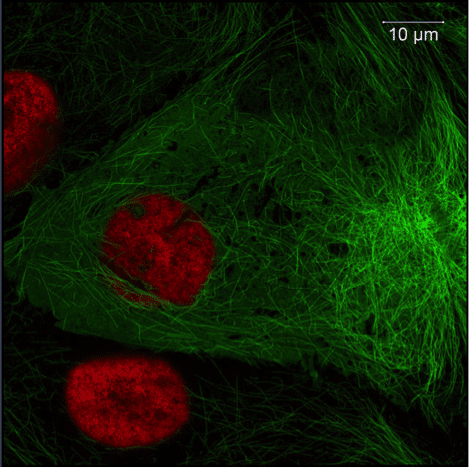
If you want the kind of fluorescent IHC images worth those extra color publication charges, you’ve come to the right place. Read on for tips and tricks to getting stellar IHC staining.
Join Us
Sign up for our feature-packed newsletter today to ensure you get the latest expert help and advice to level up your lab work.
Search below to delve into the Bitesize Bio archive. Here, you’ll find over two decades of the best articles, live events, podcasts, and resources, created by real experts and passionate mentors, to help you improve as a bioscientist. Whether you’re looking to learn something new or dig deep into a topic, you’ll find trustworthy, human-crafted content that’s ready to inspire and guide you.
If you want the kind of fluorescent IHC images worth those extra color publication charges, you’ve come to the right place. Read on for tips and tricks to getting stellar IHC staining.
My phone’s email notification went off, and I rolled over in bed to look at the clock. Saturday, 5 am. Wonderful. Who would email me at that hour? It had to be my undergraduate research PI. I unlocked my phone. Yep. Doesn’t he ever sleep? Dear Casey: We are launching a new collaborative project in…
Biosensor chip selection is a critical step in planning and running a surface plasmon resonance (SPR) experiment. Chip selection depends on the ligand or target that needs to be immobilized on the sensor chip, the analyte that is flowed over the target to study the binding, and the purpose of the biosensor assay (i.e., determination…
The traditional microscope that you know and love is operated manually. Picture the scene: the microscopist chooses the light source, gently places the sample the moveable stage, selects the objective lens, and scans to select the field of view. This process is perfect for processing and analyzing a small number of samples per day. But…
We review Open Access publishing models so you can make an informed decision about what is best for you and your research.
Successful western blotting means achieving unambiguous results, and this requires a sensitive and specific antibody-antigen interaction. Consequently, high quality antibodies are critical for reliable and consistent western blotting. Western Blotting Process In the basic western blotting process, polyacrylamide gel electrophoresis (PAGE) separates a mix of proteins according to their molecular weights (denaturing gels) or their…
In recent years, three-dimensional (3D) scanning electron microscopy techniques have gained recognition in the biological sciences. In particular, array tomography, serial block face scanning electron microscopy (SBFSEM) and focused ion beam scanning electron microscopy (FIBSEM) (described in Three-Dimensional Scanning Electron Microscopy for Biology) have shown an increase in biological applications, elucidating ultrastructural details of cells…
Surface plasmon resonance (SPR) offers highly efficient, label-free detection for quantifying biomolecular interactions in real-time. Two exciting SPR variants that have sprung up in recent years are SPR for cellular analysis and SPR-mass spectrometry (SPR-MS). SPR for cellular analysis allows you to study how cells attach to different substrates and each other, while SPR-mass spectrometry…
Today, about half of all therapeutic drug approvals by the US Food and Drug Administration (FDA) are for biological drugs. That number is expected to rise to 75 percent by 2025. When these biologics come off patent, the gates will open for a flood of biosimilar drugs (biopharmaceutical generics) that are designed to be much…
Currently, there are more than 75 antibody drug conjugates (ADCs) in various stages of pre-clinical and clinical development. The combination of a targeted antibody coupled with a cytotoxic small-molecule drug (via a flexible linker) makes for a lethal and specific oncologic drug product. However, an ADC is a heterogeneous cocktail of molecules with a range…
Surface plasmon resonance (SPR), a label-free, real-time way to examine protein binding and other molecular interactions, is getting easier as manufacturers have streamlined SPR instruments and supporting software. But problems can still arise. Troubleshooting Your SPR Assay Here are some common issues and suggestions to solve them: Inactive Targets Your target protein may have become…
If you have ever imaged biological samples, you have likely encountered autofluorescence. That pesky background coloration you see under the microscope, which can make it difficult to distinguish your actual signal from the noise.1 When you are trying to look for something as delicate as RNA, you don’t want to be hunting for your signal…
Anytime lab processes get automated by a sophisticated scientific instrument, there can be a “black box” effect, leading users to wonder what’s going on in there. For DNA electrophoresis, it’s no different. It’s easy to see what’s happening in a manual gel, but the automated gel-based DNA size selection platforms can be more mysterious. Automated…
Surface Plasmon Resonance (SPR) is the gold standard for measuring biomolecular binding without the need for labeling (i.e., label free detection of kinetics). SPR is especially valuable because it doesn’t just provide information at the start and end of a binding event, but can be used to follow association and dissociation kinetics of biomolecules in real-time….
The only constant with microscopy imaging is variability in both color and image quality. You only need to look at images in journal articles, posters, around your laboratory, or compare your images with a colleague’s—the evidence is staggering. Interestingly, variability doesn’t generally come from the digital camera, rather it comes from our use of imaging…
Scanning electron microscopy (SEM) is a powerful technique, traditionally used for imaging the surface of cells, tissues and whole multicellular organisms (see An Introduction to Electron Microscopy for Biologists)(Fig. 1). While the resultant images appear to be three dimensional (3D), they actually contain no depth information. However, there are several SEM techniques that can obtain…
If you type on a keyboard, pipette, or do anything repetitive with your hands for a long time, chances are you’ve felt it: numbness in the base of the thumb, pain in the wrist, or a weak feeling in your hand. These sensations can come from a lot of things, but the symptoms add up…
The precision and accuracy of even the best calibrated pipette can be wiped out if you choose the wrong kind of tips. Depending on the experiment you are doing, the wrong kind of tips can also make your pipette a source of contamination, lead to waste of precious samples or reagents—or even cause you physical…
When you perform genomic DNA extraction from whole blood, low yield or low quality DNA can result in many issues. No matter your intended downstream application—qPCR, next generation sequencing, Sanger sequencing, and so on—you need high quality DNA. We’ve made this step-by-step guide to assist you in getting the highest possible DNA yield and quality, and…
There are several methods for size-selecting DNA fragments prior to sequencing. How do you choose which is best? Here’s a look at various options, plus considerations to help you determine when to use each one. Manual Gels Virtually every student in a biology lab knows how to prepare and cut a manual gel—but their ubiquity…
Apoptosis, often called programmed cell death, is a carefully regulated process that is part of normal development and homeostasis. Apoptosis is morphologically and biochemically distinct from necrosis, which is conversely called accidental cell death. Dysregulation of apoptosis is implicated in disease states such as cancer, autoimmune disease and degenerative conditions. Apoptosis consists of an orderly…
When starting a long-term experiment, you need to take a lot of things into consideration (availability of cells, reagents, planning time points), but do you ever think about your antibodies? If you buy an antibody from a manufacturer, run out half way through the study, and buy the same antibody again, have you thought about…
Ask a scientist why they love their job, and they will likely tell you it’s because they get to see and discover amazing things! Why, then, does science class in school never reflect this? A major problem identified in our society is lack of science interest and literacy. Mobile labs are helping to turn the…
Size selection is a critical step in NGS pipelines, but may be most challenging for studies of small RNAs. The concept behind size selection is simple: separate a sheared DNA or cDNA sample by fragment size, and then use the resulting sizes to remove unwanted fragments. This is a tried-and-true way to get rid of…
In Part 1 of these articles, you’ll have learnt about common microscope light sources and how to replace and align these correctly. In this article, we will discuss the importance of Köhler illumination and how to set up the microscope to achieve optimal imaging results. What is Köhler illumination? Before discussing this technique, let us…
Do you want the best imaging experience each time you use a microscope? Well, this is a rhetorical question, as we all desire that these delicate optical instruments are clean, free from immersion oil and correctly aligned. From the routine checking of slides, capturing images for presentations and publications, to diagnosing diseases using point-of-care microscopes,…
It took scientists a little while to warm up to long-read sequencing, but now you couldn’t pry most of them away from their sequencers with a crowbar. Long reads — we’re talking 10,000 bases and more — provide a level of contiguity and completeness in genome assemblies that simply isn’t possible with short-read sequencers. They…
The age of sequencing is undoubtedly upon us. From improving cancer diagnostics to pinning down elephant poaching hotspots, DNA sequencing is revolutionizing the world around us from the ground up. The latest video from Thermo Fisher Scientific’s “Behind the Bench” blog, 10 moments in DNA sequencing gives fascinating insights into the amazing advances being made…
Of all the sample prep steps necessary for next generation sequencing, DNA size selection may have the greatest impact on quality of results. After all, ineffective sizing can waste sequencing capacity on low molecular weight material such as adapter-dimers or primer-dimers, while imprecise sizing can prevent bioinformaticians from producing accurate assemblies. High-quality size selection can…
Do you want to know more about the story behind some of today’s big developments in sequencing technology? Illumina recently started a video series called “Adventures in Genomics” that introduces the people working on methods and applications, making big waves in our understanding of science, biology, and medicine. The company’s most recent video covers single-cell…
Through our eyes, seeing is not always believing. Under different lighting conditions, we tend to see the same objects as having the same color. For example, an apple will appear red whether it is lit by daylight or candlelight and a white sheet of paper will be perceived as being white regardless of the light…
This article reviews the evolution of DNA binding dyes in qPCR, highlighting their role in detecting and quantifying amplified DNA. It covers the shift from ethidium bromide to safer, more sensitive dyes like SYBR Green and the advancement to probe-based methods that improve specificity and signal accuracy in PCR assays.
Using fluorescent proteins as imaging probes is a widespread and versatile technique in microscopy. You can use them in a wide range of living systems, from single cultured cells to complete organisms and animals. Fluorescently tagged proteins can be used to track and examine real-time localization, interactions, and translocation of your protein of interest, as…
If you want to see in real time what is going on inside your cell then you should be performing live-cell imaging. Live-cell imaging techniques allow real-time examination of almost every aspect of cellular function under normal and experimental conditions. With all live-cell imaging experiments, the main challenges are to keep your cells alive and healthy…
If you’ve ever performed PCR, you’re probably already very familiar with DNA oligonucleotides (or oligos). But did you know that these molecules can do so much more than just act as simple primers? You can add a wide range of modifications to your oligos, which may change the stability, binding, solubility and even visibility, to…
Have you ever been shown how to use a microscope properly? Or do you just dive right onto the microscope with little or no training and scant knowledge of the basics, then twiddle knobs, snap photos and expect the publication-quality images to appear? If it’s the latter you are certainly not alone! If only there…
Mercury burners are one of the most common light sources used in fluorescence microscopes, producing a wide spectrum of wavelengths making them a great light source for viewing your samples. But they do have their issues – one of which is their propensity to break or become damaged if not used and cared for correctly, which…
You may already use fluorescence as a tool in your microscopy and imaging work, but, do you know exactly what it is? Why are certain proteins and probes fluorescent? What causes this light emitting property? We’ll have a look at these and more questions in this article. Start with a definition We’ll start with a…
In studies of RNA abundance and gene expression, no one technique can answer all of the questions that need to be asked. So it is necessary to use a variety of experimental methods in concert. Two RNA detection and measurement techniques that complement each other well for this purpose are RNA Fluorescence in situ hybridization…
Single Nucleotide polymorphisms (SNPs), colloquially pronounced ‘snips’, are the most common type of genetic variation in people. By definition, a SNP represents a single nucleotide variation at a specific location in the genome that is found in more than 1% in the population. For example, a SNP can replace the nucleotide cytosine (C) with an…

The eBook with top tips from our Researcher community.