
In real-time PCR, there are two primary ways to detect amplicons using fluorescent monitoring. One is intercalator-based dyes such as SYBR Green, and the other is probe-based techniques (hydrolysis or hybridization probes).
All of these methods share a similar mechanism of measuring increasing fluorescence during amplification.
But there is another, completely different way to quantitatively measure PCR product without probes or DNA-binding dyes that is equally sensitive but even easier to optimize and set up. That way is the PlexorTM system, from Promega, which actually measures a decrease in fluorescence as amplicon increases.
Let me tell you a little more about this highly sensitive and powerful technique.
Choose a free resource to help you move forward
REFERENCE CARD
qPCR Efficiency & Ct Reference Card
Troubleshooting Card
RT-qPCR Method Selection
The science behind Plexor
The basic premise of this method is the specific interaction of two modified nucleotides, iso-dC and iso-dG, that pair only with each other. The way it works is that one primer is designed with a fluorescently labeled modified nucleotide iso-dC (5′ methyl iso-cytosine) on the 5′ end. The other primer is unlabeled. A proprietary dNTP mix is needed which contains free dabcyl-iso-dG (the quencher).
How it works
At the outset of the reaction, the fluorescence is high since there is an abundance of free labeled primer. During PCR, when the Taq polymerase gets to iso-dC at the end of the extension step, it incorporates the dabcyl-iso-dG and the fluorescence is quenched. The result is a loss of fluorescence as PCR product accumulates with each cycle of PCR (see figure below).
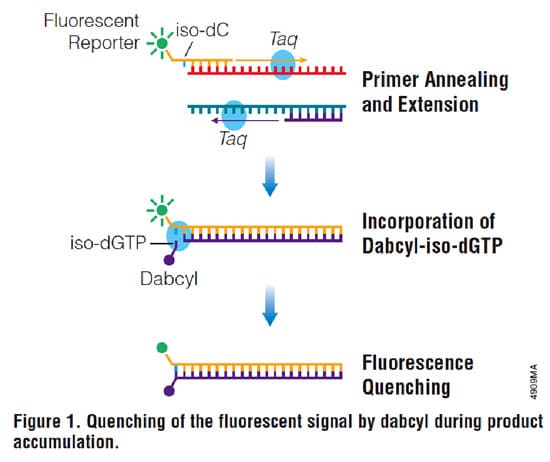
This is the exact opposite of conventional qPCR methods. And because dabcyl quenching is reversible, when the products are melted, the fluorescence goes back up. This allows for melt curve analysis to get a specific melt temperature for the PCR product.
Primer design and data analysis software available online
Just like any PCR, primer design is very important to the success of the system so Promega offers free primer design software on their website and the Plexor TM system also comes with its own data analysis software.
Both primer design and data analysis software can be downloaded freely from their website https://www.promega.com/applications/pcr/qpcr/data_analysis.htm.
Registration is required to obtain access to the primer design and analysis software, but it is a very quick, simple and easy process.
The system is also compatible with some of the most commonly used qPCR instruments on the market. Depending on the hardware, they offer comprehensive instruction manuals for the use of their chemistry.
The benefits
The PlexorTM system overcomes the issues of PCR inhibition by SYBR Green but can perform the melt curve analysis unlike hydrolysis probes. And it only requires two primers, not three, making assay design a lot simpler, especially for multiplex qPCR.
PlexorTM chemistry seems to combine all the well-known and simple features of PCR technology into a very powerful, sensitive platform for both DNA and RNA quantification.
What are your thoughts? Do (or will) you use PlexorTM
[note: no scorpions were harmed in the making of the headline photo. See the photographer’s page for more info]
You made it to the end—nice work! If you’re the kind of scientist who likes figuring things out without wasting half a day on trial and error, you’ll love our newsletter. Get 3 quick reads a week, packed with hard-won lab wisdom. Join FREE here.