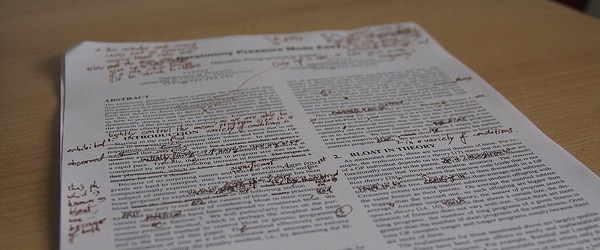
Keeping up with the scientific literature in your field of interest is incredibly important. It keeps you informed about what is happening in your field and helps shape and guide your experimental plans. But do you really know how to read a scientific paper, and can you do it effectively and efficiently?
Let’s face it, in our results-driven world, reading new scientific papers often falls by the wayside because we just don’t have the time! And when you do find some reading time, it’s tempting not to read the entire article and just focus on the abstract and conclusions sections.
But reading a scientific paper properly doesn’t need to take hours of your time. We’ll show you how to read a scientific paper effectively, what you can and can’t skim, and give you a checklist of key points to look for when reading a paper to make sure you get the most out of your time.
If speed is your bottleneck, also check out how to read manuscripts (and anything else) twice as fast. To make finding that literature easier, try these three cool things you can do on PubMed.
Choose a free resource to help you move forward
CHECKLIST
Checklist For Writing a Scientific Review
CHECKLIST
Manuscript Summary Template and Checklist
Note: Not every paper deserves the same depth of attention. For peripheral reading outside your core area, it’s often better to learn by osmosis and absorb the big picture rather than dissect every line.
Step 1: Read the Title and Abstract
The title and abstract will give you an overview of the paper’s key points. Most importantly, it will indicate if you should continue and read the rest of the paper. The abstract is often able to view before purchasing or downloading an article, so it can save time and money to read this before committing to the full paper.
Checklist: What to Look for in the Abstract
- The type of journal article. Was it a systematic review? Clinical trial? Meta-analysis?
- The aim. What were they trying to do?
- The experimental setup. Was it in vivo or in vitro, or in silico?
- The key results. What did they find?
- The author’s conclusions. What does it mean? How does it impact the wider field?
Step 2: Skip the Introduction
The introduction is mostly background, and if you are already familiar with the literature, you can scan through or skip this as you probably know it all anyway. You can always return to the introduction if you have time after reading the meatier parts of the paper.
Checklist: What to Look for in the Introduction
- Is the cited literature up to date?
- Do the authors cite only review articles or primary research articles?
- Do they miss key papers?
Step 3: Scan the Methods
Don’t get too bogged down in the methods unless you are researching a new product or technique. Unless the paper details a particularly novel method, just scan through. However, don’t completely ignore the methods section, as the methods used will help you determine the validity of the results.
You should aim to match the methods with the results to understand what has been done. This should be done when reviewing the figures rather than reading the methods section in isolation.
A Note about qPCR Data
If the data is qPCR, take the time to look even more carefully at the methods. According to the MIQE guidelines, the authors need to explain the nucleic acid purification method, yields, and purities, which kits they used, how they determined the efficiency of their assays, and how many replicates they did. There are a lot of factors that can influence qPCR data, and if the paper is leaving out some of the information, you can’t make accurate conclusions from the data.
Checklist: What to Look for in the Methods Section
- Are the controls described? Are they appropriate?
- Are the methods the right choice for the aims of the experiment?
- Did they modify commercial kits, and if so, do they explain how?
- Do they cite previous work to explain methods? If so, access and read the original article to ensure what has been done.
- Ensure adherence to relevant guidelines, e.g., MIQE guidelines for qPCR data.
Step 4: Focus on the Figures
If you want to read a scientific paper effectively, the results section is where you should spend most of your time. This is because the results are the meat of the paper, without which the paper has no purpose.
How you “read” the results is important because while the text is good to read, it is just a description of the results by the author. The author may say that the protein expression levels changed significantly, but you need to look at the results and confirm the change really was significant.
While we hope that authors don’t exaggerate their results, it can be easy to manipulate figures to make them seem more astonishing than they are. We’d also hope this sort of thing would be picked up during editorial and peer review, but peer review can be a flawed process!
Don’t forget any supplementary figures and tables. Just because they are supplementary doesn’t mean they aren’t important. Some of the most important (but not exciting) results are often found here.
We’re not advocating you avoid reading the text of the results section; you certainly should. Just don’t take the authors’ word as gospel. The saying “a picture speaks a thousand words” really is true. Your job is to make sure they match what the author is saying.
And as we mentioned above, read the methods alongside the results and match the method to each figure and table, so you are sure what was done.
A Note About Figure Manipulation
Unfortunately, figure manipulation can be a problem in scientific articles, and while the peer-review process should detect instances of inappropriate manipulation, sometimes things are missed.
And what do we mean about inappropriate manipulation? Not all figure and image manipulation is wrong. Sometimes a western blot needs more brightness or contrast to see the results clearly. This is fine if it is applied to the whole image, but not if it is selectively applied to particular areas. Sometimes there is real intent to deceive, with cases of images swapped, cropped, touched up, or repeated.
Graphs are particularly susceptible to image manipulation, with alterations to graphs changing how the data appears and a reader’s interpretation of a graph. Not starting the axis at 0 can make small differences appear bigger, or vice versa if a scale is too large on the axis. So make sure you pay careful attention to graphs and check the axes (yes, that’s the plural of axis) are appropriate (Figure 1). You should also check if graphs have error bars, and if so, what are they, and is that appropriate?

Statistics can scare many biologists, but it’s important to look at the statistical test and determine if the method is appropriate for the data. Also, be wary of blindly following p-values. You may find situations when an author says something is significant because the statistical test shows a significant p-value, but you can see from the data that it doesn’t look significant. Statistics are not infallible and can be fairly easily manipulated.
Checklist: What to Look for When Reviewing Results
- Are there appropriate scales on graphs?
- Do they use valid statistical analysis? Are results really significant?
- Have they used sufficient n numbers?
- Are the controls appropriate? Should additional controls have been used?
- Is the methodology clear and appropriate?
- Have any figures been inappropriately manipulated?
- Check the supplementary results and methods.
Step 5: Tackle the discussion
The discussion is a great place to determine if you’ve understood the results and the overall message of the paper. It is worth spending more time on the discussion than the introduction as it molds the paper’s results into a story and helps you visualize where they fit in with the overall picture. You should again be wary of authors overinflating their work’s importance and use your judgment to determine if their assertions about what they’ve shown match yours.
One good way to summarize the results of a paper and show how they fit with the wider literature is to sketch out the overall conclusions and how it fits with the current landscape. For example, if the article talks about a specific signaling pathway step, sketch out the pathway with the findings from the paper included. This can help to see the bigger picture, highlight, ensure you understand the impact of the paper, and highlight any unanswered questions.
Test Yourself
A useful exercise when learning how to read a scientific paper (when you have the time!) is to black out the abstract, read the paper and then write an abstract. Then compare the paper’s abstract to the one you wrote. This will demonstrate whether or not you are picking up the paper’s most important point and take-home message.
Checklist: What to Look For in the Discussion Section
- Do you agree with the author’s interpretation of their results?
- Do the results fit with the wider literature?
- Are the authors being objective?
- Do the authors comment on relevant literature and discuss discrepancies between their data and the wider literature?
- Are there any unanswered questions?
Step 6: File it Away
Spending a little time filing your read papers away now can save you A LOT of time in the future (e.g., when writing your own papers or thesis). Use a reference management system and ensure that the entry includes:
- the full and correct citation;
- a very brief summary of the article’s key methods and results;
- any comments or concerns you have;
- any appropriate tags.
Ways to Sharpen Your Critical Analysis Skills
While this article should get you off to a good start, like any muscle, your critical analysis skills need regular workouts to get bigger and better (for a worked example, see how to deconstruct a paper before you commit to reading it)
But how can you hone these skills?
Attend Journal Clubs
Your critical thinking skills benefit dramatically from outside input. This is why journal clubs are so valuable. If your department runs a regular journal club, make sure you attend. If they don’t, set one up. Hearing the views of others can help hone your own critical thinking and allow you to see things from other perspectives. For help and advice on preparing and presenting a journal club session, read our ultimate guide to journal clubs.
Read Online Reviews
Whether in the comments section of the article published online, on a preprint server, or on sites such as PubPeer and Retraction Watch, spend time digesting the views of others. But make sure you apply the same critical analysis skill to these comments and reviews.
These sites can be a useful tool to highlight errors or manipulation you may have missed, but taking these reviews and comments at face value is just as problematic as taking the author’s conclusions as truth. What biases might these reviews have that affect their view? Do you agree with what they say and why?
Final Thoughts on How to Read A Scientific Paper
Reading a scientific paper requires a methodical approach and a critical (but not negative) mindset to ensure that you fully understand what the paper shows.
Reading a paper can seem daunting, and it can be time-consuming if you go in unprepared. However, the process is quicker and smoother once you know how to approach a paper, including what you can and can’t skim. If you don’t have enough time, you can still read a paper effectively without reading the entire paper. Figure 2 highlights what sections can be skimmed and which sections need more of your attention.

Another tip for being more productive (and it’s better for the environment) is to read your papers on-screen. It’ll save time scrambling through a stack of papers and manually filing them away.
Want an on-hand checklist to help you analyze papers efficiently despite being busy with research? Download our free article summary and checklist template.
For more tips on keeping track of the scientific literature, head to the Bitesize Bio Managing the Scientific Literature Hub.
Originally published November 20, 2013. Updated and revised September 2022.
You made it to the end—nice work! If you’re the kind of scientist who likes figuring things out without wasting half a day on trial and error, you’ll love our newsletter. Get 3 quick reads a week, packed with hard-won lab wisdom. Join FREE here.