
Sometimes the biggest hurdle to mastering a new topic is mastering the vocabulary. To help you master optical fibers, I put together this illustrated glossary of Optical Fiber Vocabulary, a companion to our introduction to optical fibers.
Read this, and you will be speaking like a pro in no time.
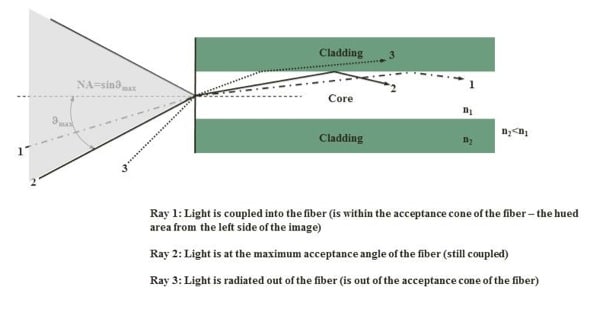
Acceptance Angle
The half-angle of the cone (Θmax in Figure 1) within which incident light is totally internally reflected by the fiber core. Applies only to MM optical fiber though!
Figure 1.
Choose a free resource to help you move forward
DOWNLOAD
Culture Contaminants Reference Card
POSTER
Histological Stains Poster
Add/Drop Multiplexing (ADM)
A device (optical element of optical fiber) that allows lower level signals to be added or dropped from a communications network (high-speed optical carrier) in a wire center [wavelength division multiplexer (WDM) transmission]. The connection to add/drop multiplexer is via a channel to a central office port at a specific digital speed (DS3, DS1, STS, etc.). Illustrated below in Figure 2. Tx=transmission of a signal, Rx=Reception of a signal.
Figure 2.
 OR
OR
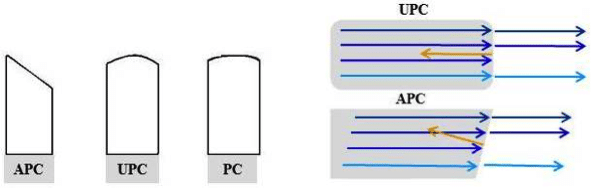
Angled Physical Contact (APC)
A type of fiber optic connector with a 5-15 angle-polished end surfaces of the connector tip to minimize backreflection. In Figure 3 the angle for APC configuration is 5÷15º.
Figure 3.
Armor
A protective layer of corrugated steel, wrapped around a cable. To prevent rodent attacks. Used in both buried and aerial applications.
Arrayed Waveguide Grating (AWG)
A device, built with (silicon) planar light wave circuits (PLC), which allows multiple wavelengths to be combined and separated (multiplexed and demultiplexed) in a dense wavelength-division multiplexing (DWDM) system. See Figure 4.
Figure 4.

Attenuation Coefficient
A coefficient characterizing the attenuation of an optical fiber per unit of length (dB/km). This coefficient corresponds to the rate of optical power loss with respect to distance along the fiber.
Back Reflection (BR)
The power reflected back toward the source in the optical link (fiber ends, fiber deformations, and connectors). Also called Fresnel reflection. See a Figure 3.
Bandwidth
The range of frequencies within which a fiber optic or a terminal device can transmit data or information.
Bandwidth – Distance Product
The frequency range that can be transmitted by the optical fiber expressed in MHz×km. Bandwidth determines the maximum transmitted information capacity of a channel that can travel unperturbed along the optical fibers over a certain distance. This is almost distance-unlimited in single-mode optical fiber, but narrow in number of frequencies, whereas is distance-limited in multimode OF (due to the modal dispersion), but large in number of frequencies.
Bend Radius
The smallest radius an optical fiber or fiber cable can bend before excessive attenuation or breakage occurs.
Bit Error Rate (BER)
The average fraction of transmitted bits that are received incorrectly. The BER of a system for optical fiber communications is influenced by noise, optical losses, dispersion, and nonlinearities.
Buffer
In optical fiber, a protective coating applied directly to the fiber.
C-Band
The wavelength range between 1530 nm and 1562 nm used in some CWDM (Coarse Wavelength Division Multiplexing) and DWDM (Dense Wavelength Division Multiplexing) applications.
Carrier-to-Noise Ratio (C/N)
The ratio of the received carrier strength to the strength of the received noise (in dB) before any nonlinear process such as amplitude limiting and detection takes place. High C/Ns provide better quality reception, and generally higher communications accuracy and reliability, than low C/Ns.
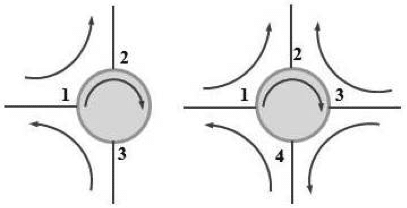
Circulator
A passive component composed of three or four ports that couples signal from one port (n) to the next port (n+1). The first port being is counted as following the last one and port n is isolated from signals in port n+1. See Figure 5.
Figure 5
Cladding Mode
Cladding mode is an undesired light ray mode that propagates in the cladding, see effective area definition.
Coarse Wavelength Division Multiplexing (CWDM)
CWDM is a method of combining multiple (minimum 8) signals/channels at various wavelengths in the 1550 nm region of optical fiber (the C-Band, vide infra). The number of channels is fewer than in dense wavelength division multiplexing (DWDM) but more than in standard wavelength division multiplexing (WDM).
Obs: CWDM systems have channels at wavelengths spaced 20 nm apart, compared with 0.4 nm spacing for DWDM.
Cleave
The process of separating an optical fiber by a controlled fracture of the glass, for the purpose of obtaining a fiber end, which is flat, smooth, and perpendicular to the fiber axis
Composite Power
The sum of the power level of each carrier of a DWDM system.
Conventional Band (C-Band)
Wavelength transmission band from 1530 to 1565 nm. Also called third window.
Cross-Phase Modulation (XPM)
The change in the phase of a signal caused by the interaction with another signal. The phenomenon is due to nonlinear Kerr optical effect occurring in the fiber and causing a change of the refractive index.
Crosstalk (XT)
- Undesired coupling from one circuit, part of a circuit, or channel to another.
- Any phenomenon by which a signal transmitted on one circuit or channel of a transmission system creates and undesired effect in another circuit or channel.
CTS (“clear to send”)
In a communications network, a signal from a remote receiver to a transmitter that it is ready to receive a transmission.
Cutback Method
A technique to measure the attenuation of an optical fiber by comparing the optical power transmitted through a fiber to the power transmitted by a short section of the same fiber.
Cutoff Wavelength
The wavelength beyond which a single-mode fiber carries only one mode/The wavelength below which the fiber ceases to be single-mode.
Data rate
The number of bits of information in a transmission system, expressed in bits per second (b/s or bps), and which may or may not be equal to the signal or baud rate.
Decibel (dB)
Unit used to express values of power (intensity) level on a logarithmic scale. The power level is always relative to a reference power P0: where P and P0 are expressed in the same linear units.
Demultiplexer (Demux)
A device that separates two or more signals previously combined (see Figure 3).
Dense Wavelength Division Multiplexing (DWDM)
A technique used to multiplex several signals on a single fiber within a narrow wavelength band. For example: the transmission of many closely spaced wavelengths in the 1550 nm region over a single OF. Wavelength spacing is usually 100 GHz (0.8 nm) or 200 GHz (1.6 nm). DWDM includes C-Band, S-Band, and L-Band (vide infra).
Dispersion-Shifted Fiber (DSF)
A type of single-mode fiber designed to have zero dispersion near 1550 nm. This fiber type is not suitable for DWDM applications, due to its high nonlinearity at the zero-dispersion wavelength.
Diplexer
A device that combines two or more types of signals into a single output. Usually incorporates a multiplexer at the transmit-end and a demultiplexer at the receiver end.
Distributed Feedback Laser (DFB)
An injection laser diode built with a Bragg reflection grating in the active region in order to avoid multiple longitudinal modes and enhance a single longitudinal mode. It produces a finer range of wavelengths than a Fabry-Perot laser, are often used in DWDM communication where a tunable laser signal is desired.
Distribution System
Part of a cable system used to carry signals from the head-end to subscriber terminals.
Double-window Fiber
1) Multimode fibers: optimized for 850 nm and 1310 nm operation. 2)Single mode fibers: optimized for 1310 nm and 1550 nm operation.
Dynamic Range
A characteristic of an Optical Time Domain Reflectometer (OTDR). Depending on the noise level reference, there are a couple of definitions:
- IEC Dynamic Range (introduced by Bellcore) where the upper level of the noise is taken as the upper limit of a range, which contains at least 98% of all noise data points.
- RMS Dynamic Range is the root mean square (SNR=1) dynamic range that corresponds to the difference between the extrapolated point of the backscatter trace at the near end of the fiber (taken at the intersection between the extrapolated trace and the power axis) and the RMS noise level. This determines the maximum observable length of a fiber and, therefore, the OTDR suitability for analyzing any particular network.
Effective area (EA)
Area of the fiber corresponding to the mode field diameter. See Figure 6.
Figure 6.
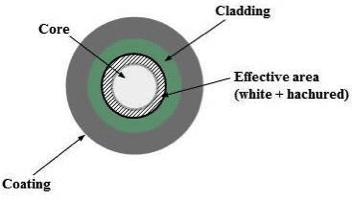
EA determines the power density of the light injected into the fiber, ie small EA ? high power density ? important nonlinear effects. The EA of a standard single-mode optical fiber is around 80?m, and can be as low as 30?m for compensating fibers. The value of EA is included usually in the description of the fiber’s name.
Equilibrium Mode Distribution (EMD)
In multimode fibers, EMD is a steady state mode distribution. When achieved, the relative power in modes is stabilized and the distribution of light travels in the medium without any disturbance or leakage/gain.
Equilibrium Length (equilibrium coupling length, equilibrium mode distribution length)
The length of multimode fiber necessary to reach the equilibrium mode distribution for a specific excitation condition. Also called equilibrium coupling length and equilibrium mode distribution length.
Encircled flux (EF)
The ratio between the transmitted power at a given radius of the core and the total injected power.
Figure 7.
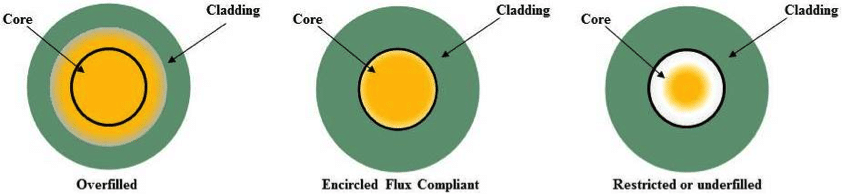
EF is related with the power distribution inside the fiber core, the spot size of the light source (LED, VCSEL, and laser) and the alignment of the beam into the fiber. All of these are called ‘launching conditions’. Launching conditions affect attenuation in the fiber. An ideal situation is illustrated in the second image in Figure 7 above. .
Equilibrium Mode Distribution (EMD)
The steady modal state of a multimode fiber in which the relative power distribution among modes is stabilized and independent of fiber length (light travels in the medium without any disturbance or leakage/gain). The spot diameter is around 70% of core diameter.
Equilibrium Length (equilibrium coupling length or equilibrium mode distribution length)
The length of multimode fiber that is necessary to reach the equilibrium mode distribution for a specific excitation condition.
Extended Band (E-Band)
A transmission band for wavelength from 1360 to 1460 nm.
Extinction Ratio
The ratio of the low/OFF optical power to the high/ON optical power, expressed as a percentage [(PL/PH) x 100].
Extrinsic Loss:
In a fiber interconnection, the portion of loss due to imperfect joining of a connector or splice.
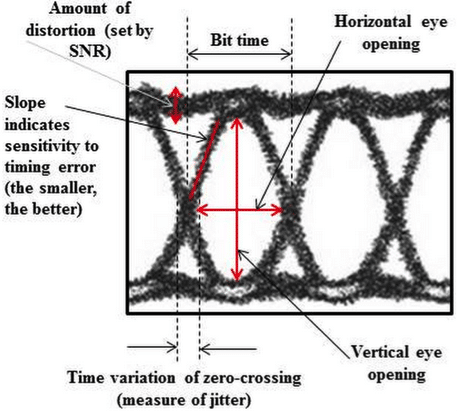
Eye Pattern
An oscilloscope display that allows several system performances measurements. The “openness” of the eye relates to the BER that can be achieved. The vertical eye opening indicates the noise level in the system: the more it is opened the less noise level. The horizontal eye opening is related to the amount of jitter in the signal: the wider the opening, the less jitter. At higher data rates the profile thickens. See Figure 8.
Figure 8.
Fabry-Perot (FP)
Generally refers to any device (e.g., laser diode) that uses mirrors in an internal cavity to produce multiple reflections.
Far-End Crosstalk
The ratio of the optical power going out from a one output port compared to the optical power going out from another output port, nominally isolated from the previous one. Expressed in dB.
Faraday Effect (Magneto-Optic Effect)
A phenomenon that causes some materials to rotate the polarization of light in the presence of a magnetic field parallel to the direction of propagation.
FC/PC
A threaded optical connector that uses a special curved polish on the connector for very low backreflection. Good for single-mode or multimode fiber.
FDDI (Fiber Distributed Data Interface)
1) A dual counter-rotating ring local area network. 2) A connector used in a dual counter-rotating ring local area network.
Ferrule
A mechanical fixture, generally a rigid tube, used to confine and align polished or cleaved fiber ends in a connector.
Fiber Fuse
A mechanism whereby the core of a single-mode fiber can be destroyed at high optical power levels (>2 MW/cm2). The reflection from the damage vaporizes the fiber immediately before its destruction. While this new defect remains reflective, part of the signal propagates back toward the transmitter.
Fiber Grating
An optical fiber in which the refractive index of the core varies periodically along its length, scattering light in a way similar to a diffraction grating, and transmitting or reflecting certain wavelengths selectively.
FIT Rate
Number of device failures in one billion device hours.
Four wave mixing (FWM)
A nonlinearity common in DWDM systems where multiple wavelengths mix together to form new wavelengths, called interfering products. Interfering products that fall on the original signal wavelength become mixed with the signal, “mudding” the signal, and causing attenuation. FWM depends on factors as dispersion, effective area, and channel spacing:
Interfering products on either side of the original wavelength can be filtered out. FWM is most prevalent near the zero-dispersion wavelength and at close wavelength spacing.
Frequency-Division Multiplexing (FDM)
A method of deriving two or more simultaneous, continuous channels from a transmission medium by assigning separate portions of the available frequency spectrum to each of the individual channels.
Fresnel Reflection Loss
Reflection loss at fiber ends due to the difference between glass and air refractive index. The maximum reflection caused by a perpendicular air-glass interface is about 4% or about -14 dB.
Full-Duplex Transmission
Simultaneous transmissions in both directions.
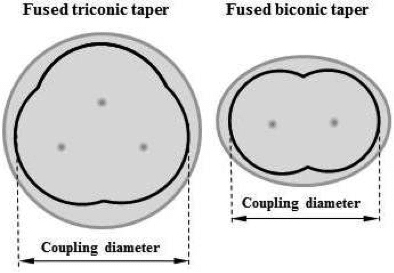
Fused Coupler
A method of making a multimode or single-mode coupler by wrapping fibers together, heating them, and pulling them to form a central unified mass so that light on any input fiber is coupled to all output fibers.
The devices are bidirectional and offer low backreflection. The technique is best suited to single-mode and multimode couplers.
Figure 9.
Fused Fiber
A bundle of fibers fused together so they maintain a fixed alignment with respect to each other in a rigid rod. See Figure 9.
Fusion Splice
A permanent joint of N (?2) fibers made by heating and fusing them together.
Gap Loss
Power loss resulting from the end separation of two aligned fibers.
Gain Slope
The slope of the gain spectrum over a determined range of wavelengths, which corresponds to the slope of least mean square regression line of total signal spectrum peaks. Gain slope is expressed in dB/nm.
Group Index
The velocity of light in a vacuum (c), divided by the group velocity of the mode. Also called group refractive index.
Group Velocity
The velocity with which the envelope of the wave propagates through space.
Hard-Clad Silica Fiber (HCS Fiber)
A type of optical fiber composed of a silica core surrounded by a hard polymer or similar material, which is much stronger than the customary cladding material.
Hybrid Fiber Coax (HFC)
A transmission system or cable construction that combines both fiber optic transmission and copper coax transmission.
HFC (Hybrid Fiber Coax)
A transmission system or cable construction (illustrated) that incorporates both fiber optic transmission components and copper coax transmission components.
In-Line Amplifier
An optical device (such an EDFA) that reinforces the signal in a optical link. This allows pursuing the transmission over distance.
Insertion Loss
Optical power loss that results from a splice or from inserting a device (such as a connector or a coupler) into a previously continuous transmission path.
Insertion Loss = Power entering the device (in dB) – Power exiting the device (in dB)
Inter-channel Isolation (crosstalk)
The ability to prevent undesired coupling from one channel to another.
Interferometer
An instrument that uses the principle of interference of electromagnetic waves for purposes of measurement. Used to measure a variety of physical variables, such as displacement (distance), temperature, pressure, and strain.
Interferometric Intensity Noise (IIN)
Noise generated within optical fiber. This disturbance is caused by the distributed back reflection that is generated by Rayleigh scattering. OTDRs measure this scattering power to deduce the fiber attenuation over distance.
Intermodulation (Mixing)
A fiber nonlinearity mechanism that occurs because the refractive index of glass is power-dependent. Signals hit each other (beat together) and generate interferences at different frequencies. Similar to Four Wave Mixing.
Intersymbol Interference
In a digital transmission system, distortion of the received signal, manifested in the temporal spreading and consequent overlap of individual pulses to the degree that the receiver cannot reliably distinguish between changes of state, i.e., between individual signal elements. At a certain threshold, intersymbol interference will compromise the integrity of the received data. Intersymbol interference may be measured by eye patterns
Intrinsic Loss
Loss due to differences in the fibers being spliced.
Jacket
The outer protective covering of a cable. Also called cable sheath.
Jitter
Small and rapid variations in the timing of a waveform due to noise, changes in component characteristics, supply voltages, imperfect synchronizing circuits, etc. See also DDJ, DCD, and RJ.
Jumper
A short fiber optic cable with connectors on both ends.
kBaud
One thousand symbols of data per second. Equivalent to 1 kb/s for binary signaling.
Kevlar
A very strong, very light, synthetic compound developed by DuPont which is used to strengthen OF.
Keying
Generating signals by the interruption or modulation of a steady signal or carrier.
Large Effective Area Fiber (LEAF)
An optical fiber developed by Corning, designed to have a large area in the core, which carries the light.
Large Core Fiber
Usually, a fiber with a core of 200 µm or more.
Lateral Displacement Loss
The attenuation that results from lateral misalignment between two fibers or between a fiber and an active device.
Launch Fiber
An optical fiber used to couple and suitably redistribute light from an optical source into an optical fiber. Often, the launching fiber is used to create an equilibrium mode distribution in a multimode fiber.
Light Piping
Use of optical fibers to illuminate.
Local Area Network (LAN)
A communication link between two or more points within a small geographic area, such as between buildings. Smaller than a metropolitan area network (MAN) or a wide area network (WAN).
Long Wavelength Band (L-Band)
A transmission band for wavelength from 1565 to 1625 nm. Part of third window.
Loose-Tube Buffering
A type of fiber optic cable construction where fibers are contained within an outer protective tube yet can move to some extent.
Loss Budget
An accounting of overall attenuation in a system. See optical link loss budget.
Lossless Compression
1) Reduction of the storage size of digital data by employing one or more appropriate algorithms in such a way that the data can be recovered without losing integrity. 2) Reduction of the amount of data that needs to be transmitted per unit time though an analogous real-time process that does not compromise the ability to completely restore the data.
Lossy Compression
Reduction of the bit-rate for an image signal by using algorithms that achieve a higher compression than lossless compression. Lossy compression presents loss of information and artifacts that can be ignored when comparing to original image. Lossy compression takes advantage of the subtended viewing angle for the intended display, the perceptual characteristics of the human eye, the statistics of image populations, and the objective of the display. 2) Removal of redundant bits from an image in video technology producing a minor loss of image quality.
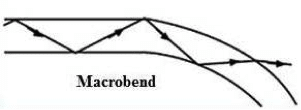
Macrobending
All macroscopic deviations of the fiber’s axis from a straight line that will cause light to leak out of the fiber, and consequently signal attenuation. See Figure 2.
Figure 10.
MAN (Metropolitan Area Network)
A network covering an area larger than a LAN. A series of local area networks, usually two or more, that cover a metropolitan area.
Mean Launched Power
The average power for a continuous valid symbol sequence coupled into a fiber.
Mechanical Splice
A technique used to join two fibers permanently using fixtures or materials (unlike thermal fusion).
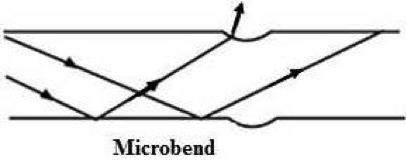
Microbending
Sharp and microscopic stresses (caused by external factors such as cabling) on a fiber that introduces local discontinuities, which results in light leaking from the core to the cladding by a process called mode coupling. See Figure 3.
Figure 11.
Minimum Bend Radius
The smallest radius an optical fiber or fiber cable can be bent before increased attenuation or damage occurs.
Mode Coupling
The transfer of energy between modes. In a fiber, mode coupling occurs until equilibrium mode distribution (EMD) is reached.
Modal (Multimode) Dispersion
Dispersion resulting from the different transit lengths of different propagating modes in a multimode optical fiber.
Modal Noise
Signal disturbances that occur whenever the optical power/signal propagates through mode-selective devices. Usually related to laser light sources.
Mode field diameter (MFD)
The section of the fiber through which the majority of the light energy is passing. See Figure 4. It’s larger than the physical diameter of the core. This phenomenon occurs because some of the light energy travels also through the cladding (this light is the evanescent wave). Optical fibers with large MFD are less sensitive to lateral offset during splicing, but present higher loss when bent.
Figure 12.
Mode Scrambler
A device that mixes modes to uniform power distribution.
Mode Stripper
A device that removes cladding modes.
Multiple Reflection Noise (multipath interference)
The fiber optic receiver noise resulting from the interference of delayed signals from two or more reflection points in a fiber optic span.
Multiplexer
A device that combines two or more signals into one output.
Whew! Well, I hope that helps get you started.
You made it to the end—nice work! If you’re the kind of scientist who likes figuring things out without wasting half a day on trial and error, you’ll love our newsletter. Get 3 quick reads a week, packed with hard-won lab wisdom. Join FREE here.


