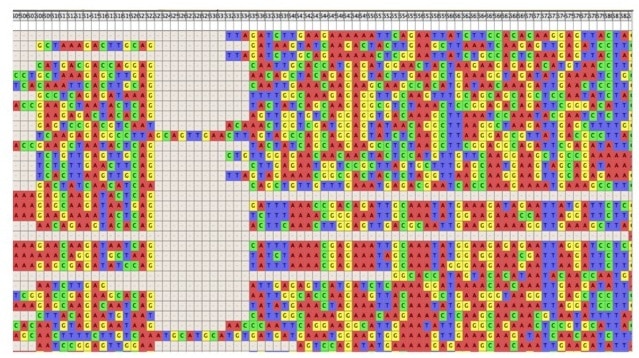
The Human Genome Project was successful, but hard work. The major improvements to the technology were the increases in parallelization and automation.
In 2003, just as the HGP completion papers were published in Nature and Science, ABI launched the‘3730XL’. It could run 24 96-well plates per day and generate around 2 MB of sequence. Some people thought they could do better. Here’s the history of sequencing up until now.
1950-60s: It all started with proteins
The earliest methods for sequencing were developed for proteins. In 1950, Pehr Edman published a paper demonstrating a label-cleavage method for protein sequencing which was later termed “Edman degradation”. Around the same time Fred Sanger was developing his own labelling and separation method which led to the sequencing of insulin. For this work, Sanger was awarded the 1958 Nobel Prize for Chemistry. Leap forward ten years and Fred Sanger was sequencing once again, this time it was RNA- demonstrating the first version of electrophoretic sequencing as we know it today (Brownlee et al., 1968).
1970s: Plus and minus
Fast-forward once again to the 1970’s and we find Fred Sanger still at the forefront of nucleic acid sequencing. In 1975 whilst at the Laboratory of Molecular Biology in Cambridge, Fred Sanger developed the “plus and minus” method for DNA sequencing (Sanger and Coulson, 1975). Again there was competition in the field with Maxam and Gilbert working on degradation sequencing (Maxam and Glibert, 1977) however, their method was ultimately to falter due to the ease and quality of the Sanger method.
Choose a free resource to help you move forward
EBOOK
Gene Editing 101
DOWNLOAD
Blood Collection Tube Chart
Got any spare ddTTP?!
After refining the plus and minus technique, the seminal 1977 PNAS article was published (Sanger et al., 1977). The research was kick started by a conversation with Klaus Geider from the Max-Planck Institute who had some ddTTP he was willing to share! The use of the ddTTP (which can cause termination of an elongating DNA molecule) was so startlingly good that Fred Sanger and Alan Coulson had to produce their own supply of the other three ddNTP’s. The results back then were essentially the same as the Sanger sequencing we are familiar with. The Sanger sequencing we use today would not have been possible without many other developments and improvements- shotgun cloning, PCR, ‘Phred’(used to identify a sequence from fluorescence data), simple DNA extraction methods, and so on.
Happy birthday to you
For his work on DNA sequencing Fred Sanger was awarded the G.W. Wheland Award (1978); the Gairdner Foundation Annual Award (1971), the Louisa Gross HorwitzPrize (1979), the Albert Lasker Basic Medical Research Award (1979); the Biochemical Analysis Prize of the German Society for Clinical Chemistry and the Nobel Prize in chemistry (1980). Fred Sanger was 94 last month- in 2018, let’s hope we can celebrate his 100th and DNA’s 65th birthdays!
The Human Genome Project (HGP)
In the years following the 1977 Sanger paper, DNA sequencing with terminating nucleotides was improved. Back then, DNA sequencing was performed in four separate tubes, the products were radioactively labelled and each gel had four tracks from which the DNA sequence was literally read-off to some kind (and no doubt, bored) person in your lab. Fortunately, Sanger sequencing benefitted enormously from commercial development by Applied BioSystems and others. Four-color dNTPs (Smith et al., 1985) meant single-tube reactions could be performed thereby simplifying the sample prep. Automated DNA sequencers (Smith et al., 1986) such as the ‘373’ ran slab-gels with 32 samples per run. A series of instruments followed and ABI moved to 96 samples on the ‘377’,capillary sequencing on the ‘3700’ (though not a great instrument) and finally, high-throughput 96-lane capillary sequencing on the ‘3730XL’ where sequences are produced automatically with quality scores. Today this is the workhorse of DNA sequencing providers.
1980-1990s: Facing a gargantuan task
In the mid 1980’s, scientists began to talk about the possibility of sequencing the complete Human genome. It seemed a gargantuan task- perhaps even an impossible one. The HGP formally began in 1990 and was completed in 2003. In 1998, Craig Venter launched Celera Genomics and the race was on to complete the Human genome. During the whole project, costs per base sequenced dropped over 100-fold. The estimated cost of the HGP was $300M-$3B, while the actual bulk of the sequencing cost around $300M, there was a huge investment in genome sciences, which underpinned the development of sequencing methods. Then in 1996, Mustafa Ronaghi published his paper on pyrosequencing (Ronaghi et al., 1996), a new method very different from previous ones.
2000s: The first of the next
The first of the so-called ‘next-generation sequencing’ technology was not a DNA sequencer per se but rather an application. Massively Parallel Signature Sequencing (MPSS) was commercialized by Lynx Therapeutics in the 1990’s and used cDNA sequencing to generate gene expression profiles. It was the first RNA-seq protocol and was purchased by Illumina (more about them later).
In 2005, Jonathan Rothberg and colleagues published the 454 System, demonstrating how, in a single run, they could sequence the genome of Mycoplasma genitalium (a small parasitic bacterium; Margulies et al., 2005). Just three years later they published the genome of none other than James Watson (see our article explaining the Roche 454 System). This 454 System made use of a new technique called ‘emulsion PCR’ (Nakano et al., 2003).
The birth of Solexa
At the same time as Jonathan Rothberg was building 454, two scientists from the University of Cambridge were building another next-generation sequencing company. Shankar Balasubramanian and David Klenerman developed the ‘sequencing-by-synthesis’chemistry and started a company called Solexa. After acquiring the bridge-amplification technology they lunched the Solexa ‘1G’ instrument. This was the first time a sequencer was capable of generating 1GB of data in a single run.
Still the most popular
The first reads were only 26 bases long and were difficult to make use of for many applications. However, the technology was so promising that in 2007, Illumina paid $600M for the technology and rebranded the ‘1G’ as the ‘Genome Analyser 1’.The technology was described in a rather overdue paper demonstrating the sequencing of a Human genome (Bentley et al., 2008). Three year later, Illumina launched the ‘HiSeq 2000’, which is today the most widely adopted (whole) genome sequencer (you can read more about the Illumina technology in this article).
George Church and colleagues developed ‘Polony’ sequencing by ligation (Shendure et al., 2005), which was later commercialized by Applied Biosystems as the ‘SOLiD’ instruments. However, this was always behind Illumina in read-length and yield, and used a more complex emulsion PCR sample preparation. In 2010, ABI purchased Ion Torrent- a company founded by Jonathan Rothberg which had developed a sequencing technology very similar to 454, but using the release of H+ protons as the detection chemistry and completing the sequencing on a semiconductor chip (Rothberg et al., 2011).
2010s-present: Fighting the big three
At least one other NGS technology has fought against the ‘Big Three’ (454, Illumina, Life Technology). Complete Genomics developed a novel sequencing system using DNA nanoballs and unchained sequencing by ligation (Lee et al., 2010). Complete Genomics perform all of their sequencing in-house as a service, rather than selling instruments and consumables, and generate genomes at a cost comparable to Illumina.
References
- Bentleyet al., (2008) Accurate whole human genome sequencing using reversible terminator chemistry. Nature 456:53-59. https://www.nature.com/nature/journal/v465/n7297/full/nature09004.html
- Brownlee, Sanger and Barrell (1968) The sequence of 5 s ribosomal ribonucleic acid. J Mol Biol. 34:379-412. https://www.ncbi.nlm.nih.gov/pubmed/4938553
- Leeet al., (2010) The mutation spectrum revealed by paired genome sequences from a lung cancer patient. Nature 465:473-477. https://www.nature.com/nature/journal/v465/n7297/full/nature09004.html
- Margulies et al., (2005) Genome sequencing in microfabricated high-density picolitre reactors. Nature 437:376-380. https://www.nature.com/nature/journal/v465/n7297/full/nature09004.html
- Maxam and Gilbert (1977) A new method for sequencing DNA. PNAS 74:560-564. https://www.pnas.org/content/74/2/560.abstract
- Nakanoet al., (2003) Single-molecule PCR using water-in-oil emulsion. J Biotech 102:117-124. https://www.nature.com/nature/journal/v465/n7297/full/nature09004.html
- Sanger and Coulson (1975) A rapid method for determining sequences in DNA by primed synthesis with DNA polymerase. J Mol Biol. 94:441-446. https://www.sciencedirect.com/science/article/pii/0022283675902132
- Sanger, Nicklen and Coulson (1977) DNA sequencing with chain-terminating inhibitors. PNAS 74:5463-5467. https://www.ncbi.nlm.nih.gov/pubmed/271968
- Shendureet al., (2005) Accurate multiplex polony sequencing of an evolved bacterial genome. Science 309:1728-1732. https://www.nature.com/nature/journal/v465/n7297/full/nature09004.html
- Smith et al., (1985) The synthesis of oligonucleotides containing an aliphatic amino group at the 5? terminus: synthesis of fluorescent DNA primers for use in DNA sequence analysis. NAR 13:2399-2412. https://www.ncbi.nlm.nih.gov/pmc/articles/PMC341163
- Smith et al., (1986) Fluorescence detection in automated DNA sequence analysis. Nature 321:674-679. https://www.ncbi.nlm.nih.gov/pubmed/3713851
- Ronaghiet al., (1996) Real-time DNA sequencing using detection of pyrophosphate release. Anal. Bio. 242:84-89. https://www.sciencedirect.com/science/article/pii/S0003269796904327
- Rothberget al., (2011) An integrated semiconductor device enabling non-optical genome sequencing. Nature 475:348-352. https://www.nature.com/nature/journal/v465/n7297/full/nature09004.html
You made it to the end—nice work! If you’re the kind of scientist who likes figuring things out without wasting half a day on trial and error, you’ll love our newsletter. Get 3 quick reads a week, packed with hard-won lab wisdom. Join FREE here.