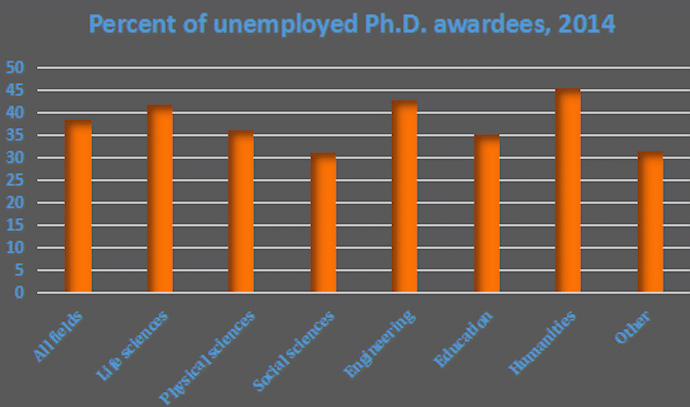
The traditional career pathway for most scientists is to get a degree, a postdoc, and then a permanent position.
But in the 21st century, a PhD no longer ensures security or a smooth career path.
Your career plan is in your hands, and this means you must proactively control your professional identity. Here’s how you can do that.
The Two Forces Shaping the Modern Labor Market
Two forces challenging this reliance on technological expertise for stability, which I will discuss in this article, are technological disruption and the nature of the modern labor market.
Choose a free resource to help you move forward
DOWNLOAD
The Happy Scientist Reference Pack
GUIDE
How to Get Clarity and Hold On To It
1. Labor Shifts in Scientific Occupations due to Technology
The possibility of technology replacing human labor is not new. Although much of the conversation these days is about Artificial Intelligence (AI) and automation, since the Industrial Revolution and the Luddite movement, technological improvements have been seen as an impending threat to labor.
Just as power looms changed work in the textile industry, AI technology is changing white-collar work today. Recognizing that this disruption is cyclical, not unprecedented, allows you to accept adaptation as a normal professional requirement rather than a special crisis.
2. The Present-Day Labor Market and Boundaryless Career Patterns
The labor market has also shifted toward “boundaryless careers,” characterized by frequent transitions, project-based work, and the gig economy. In this environment, depending entirely on an organization for career direction is no longer viable.
In the old “career staircase” model, hard work guarantees access to the next promotion or job. But the new “career mountain” is complex, and there isn’t only one route to the top. You’ll be making lateral shifts and taking detours as you adapt to changing conditions, such as funding cuts and new technologies.
Three Career Resilience Strategies for Scientists
By framing career sabbaticals and retraining as natural stages of a career journey, we normalize what was previously perceived as failure. To conquer this new terrain, you can employ three specific strategies: establishing expertise, enriching others, and expanding networks.
1. Making Your Technical Expertise Visible
In an overcrowded marketplace, you must demonstrate your expertise to be seen. But what does this look like in practice?
You may begin by updating your online professional profiles. Incorporate keywords in your LinkedIn profile relevant to your field. Rather than referring to yourself as “Postdoc,” use “Immunologist working on T cell exhaustion in solid tumors.” Keywords like “flow-cytometry,” “CRISPR,” and “Clinical trial design” allow recruiters to find you more easily.
Here are some other specific actions you can take on LinkedIn:
- Today, add three technical skills to the “Skills” section on your profile.
- This week, adjust your headline so it actually reflects what you do, not just the title that appears in the company directory.
- During this month, revise your “About” section, inserting three to five searchable keywords from your industry.
You can also show value by explaining complex scientific knowledge to your LinkedIn network. This ability to synthesize and convey information is valued by employers and can be demonstrated through the following activities:
- About once a month, summarize one recent paper in your field (3-4 phrases) in a post
- After conferences, share three summary points about what you learned at the event
- When you read something you liked, share it with a one-sentence explanation of its importance
If you are saying to yourself, “I don’t have time for social media,” ask what your time is worth. Most posts take 10 minutes to write and reach hundreds of people, whereas a coffee chat only touches one person.
2. Using Professional Generosity to Build Reputation
Career resilience strengthens when you adopt the mindset of a “favor economy millionaire.” This approach involves sharing useful insights and resources or providing help without immediately expecting anything in return.
It is not about becoming a people pleaser, but about demonstrating strategic kindness. This could include:
- Sharing your grant template with a peer who is working on their first.
- Introducing two people who are working on adjacent problems and should know each other
- Sending someone a useful paper with a note: “Thought of you when I read this.”
- Answering a genuine question on a forum in your expertise area
- Reviewing someone’s conference abstract (when you have capacity)
This works because sharing tacit knowledge contributes to positive personal branding and organizational performance. When you help others, you build a reputation for dependability and resourcefulness. You decide what you have capacity for. “I can’t take this on right now, but here’s a resource that might help” is a perfectly valid form of enrichment.
3. Sustaining Professional Networks Through Routine Contact
Treat networking as a routine practice you perform consistently rather than a desperate measure you take only when job hunting. Just as daily hygiene maintains your health, consistent networking maintains your professional viability. What this actually means for busy scientists who hate the word “networking” is small, repeatable actions. For example:
- Once per month: Message someone whose paper you cited in your own work
- After departmental seminars: Follow up with one question by email to the speaker
- Keep a running list: Note people doing adjacent work when you encounter them
- When someone helps you: Send a genuine thank-you within 24 hours
Alumni Networks
Tapping into alumni networks is a high-yield strategy. Alumni are often willing to provide intelligence on different career paths or roles. If your university has a directory, search for people in roles that interest you. A brief message: “I noticed you transitioned from X to Y. Would you be up for a 15-minute call?” has a surprisingly high response rate.
Informational Interviews
Brief conversations with industry specialists allow you to gather information about a company or role before applying. These don’t need to be formal. A 20-minute video call where you ask three specific questions counts.
Recruiters
Connecting with recruiters and hiring managers on professional platforms can lead to direct inquiries about open positions. When you connect, attach a note: “I specialize in [specific area]—happy to connect.”
Personal Branding in a Scientific Context
Many scientists reject “personal branding,” seeing it as ingenuous or shallow.
However, you probably already engage in personal branding through accepted academic practices. By presenting a poster at a conference, you have already framed how people understand your expertise. Publishing a paper contributes to your broader research identity. It is branding when someone says, “You should speak with Dr. Smith, she is a CRISPR expert.”
Personal branding is a strategic process of creating and preserving a positive impression to signal a specific promise to a target audience. It’s based on signaling theory, where you communicate distinctive traits to differentiate yourself in an imperfect market.
This distinction matters because in a market where information is asymmetric (i.e., where employers can’t instantly assess your full capabilities), you need to clearly signal what you offer.
Identifying Your Points of Professional Differentiation
Effective branding requires identifying your points of differentiation: unique combinations of skills, values, and attributes.
For you as a scientist, this might mean highlighting a specific set of technical research skills alongside your ability to communicate those findings to non-specialist stakeholders. Or it might be your experience in bridging wet-lab and computational approaches. Or your track record of troubleshooting difficult protocols that others abandon.
As a practical exercise, try listing three things you’re known for in your lab. Those are your differentiation points. Now ask: are they visible to people outside your lab? If not, make it so!
Career Development as Ongoing Practice
Establishing a resilient career is an ongoing process. It requires regular introspection to determine which aspects of your experience are enjoyable and viable in the current market. When you see your degree as a tool for employment, and when you are engaged in regular professional networking, you can build a resilient career despite technological changes.
You do not need to predict the future, but just be flexible enough to handle it. A monthly career maintenance plan in this brave new world could include:
- Revising any one section of your professional profile (LinkedIn headline or About section).
- Dropping a message to one person (whose work you truly admire or quote).
- Sharing one insight, such as a paper summary, conference takeaway, or technical tip.
- Reflect on whether your skills are aligned with the roles you want once a quarter
When you’re weighing one of those shifts, it helps to run a low-stakes career experiment before you commit. To learn more about taking charge of your career as a scientist, get a copy of Dr. Nonterah’s newest book, Navigating the P.I.V.O.T.
References
Gorbatov, S., Khapova, S.N. and Lysova, E.I. (2019) ‘Personal branding: A systematic review and future research agenda’, Frontiers in Psychology, 9, 2238. Available at: https://www.frontiersin.org/journals/psychology/articles/10.3389/fpsyg.2018.02238/full
McAlpine, L. and Castelló, M. (2015) ‘What do PhD graduates in non-academic careers actually do?’, Learning and Teaching: The International Journal of Higher Education in the Social Sciences, 8(1), pp. 1–25. Available at: https://www.berghahnjournals.com/downloadpdf/view/journals/latiss/17/1/latiss170105.pdf
Subaveerapandiyan, A. and Shimray, S.R. (2024) ‘The evolution of job displacement in the age of AI and automation: A bibliometric review (1984–2024)’, Open Information Science, 8, 20240010. https://doi.org/10.1515/opis-2024-0010. Available at: https://www.degruyterbrill.com/document/doi/10.1515/opis-2024-0010/html
You made it to the end—nice work! If you’re the kind of scientist who likes figuring things out without wasting half a day on trial and error, you’ll love our newsletter. Get 3 quick reads a week, packed with hard-won lab wisdom. Join FREE here.