
New Channels on Bitesize Bio

To help you find information on exactly what you need we're implementing channels, a new way to browse content

Each channel is focused on a specific technique or area and authored/presented by hand-picked authors who are experts in their field. Make sure you don't miss a thing by checking the box below for each channel that interests you.

In return we'll send you one email per month that brings you the latest from your chosen channel(s), along with free members-only content.

Check out our upcoming new channels; Flow Cytometry and Cell Culture, we'll be launching them very soon!

I would like to receive the newsletters for the following channels

Cell Culture
Flow Cytomery
Microscopy & Imaging
Next Generation Sequencing
Writing, Publishing and Presenting
Cloning & Expression


My email address is:

duplicate transfer

How to transfer one SDS-PAGE gel onto two membranes

From the Bitesize Bio channel

Have you ever wished you could transfer the same SDS-PAGE gel twice? Sometimes, when you are blotting for many different proteins of similar size, stripping and reprobing multiple times can become impractical.  Here’s a simple diffusion transfer method that can be used to generate duplicate membranes from a single gel:

  • Take a glass plate, or something that is similarly sturdy and flat.
  • Layer the following onto the glass plate in order, smoothing each layer out to remove air bubbles:
    • Three pieces of blotting paper (e.g. Whatman 3MM) that have been soaked in phosphate-buffered saline (PBS).
    • Lay out a pre-soaked membrane (I’ve only tested nitrocellulose, but PVDF should be fine).
    • Your gel.
    • Another pre-soaked membrane.
    • Three more pieces of PBS-soaked blotting paper.
  • Add another glass plate.
  • Tightly wrap the whole sandwich in plastic wrap.
  • Place a heavy object (e.g. a 1L bottle of buffer) on top.
  • Go home for the night, or for the weekend.
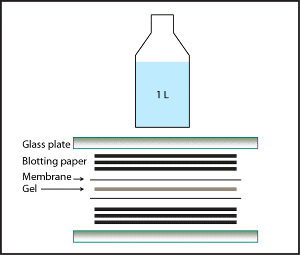
Protein transfer by this diffusion method is much slower than electrotransfer, but if you give it enough time, it is surprisingly efficient.  However, it is not recommended for very large proteins. Also, don’t forget that you will have about half as much protein on each membrane compared to transferring to only a single membrane.

Try this method out, and let us know how it goes!  It sounds too low-tech to work, but the few times that I’ve tried it has given me great results.

Articles in your inbox

Enter your email to be informed when we publish more articles like this on BsB, and also get access to all of these goodies:

  • Free ebooks and audiobooks on the topics that matter to you
  • Access to Member’s-only articles and Videos
  • Advance notice of new webinars and eBooks
  • Access to make comments and ask questions on BsB


What to read next

SDS-PAGE: The Easy Way to Find the Wells

If you have ever attempted to load a SDS-PAGE gel only to miss the well, stab the divider, and then watch helplessly as your sample squirts off into the wrong well, then this tip is for you. The fortunate among us are able to use pre-cast gels with the wells outlined on the gel plate, [...]

5 ways to destroy your Western blot

Western blotting is a common lab technique used to detect and analyze proteins. It also happens to be a really long and complicated procedure, with many steps along the way that are easy to mess up. How do you make sure that your Western blot is successful? Avoid the following five ways to destroy your [...]

About the author

Cristy Gelling

Cristy is an antipodean postdoc who is surprised to find herself in Pittsburgh, Pennsylvania giving human diseases to yeast. She sincerely hopes the yeast don't hold it against her and that the results eventually make a difference to the lives of...

What do you think?

5 comments

  1. from on

    Excellent idea, Cristy!

    One thing that seemed to be omitted was some sort of soaking. Is the pre-soaked filter paper sufficient to keep the membrane from drying out overnight?

    Also, do you have some results that demonstrate the efficacy of the method? Intuitively, it seems one might get better transfer to the membrane at the bottom of the sandwich.

    Thank you! I would love to try this out!

    • from on

      Hi,
      The sandwich won’t dry out, as long as you wrap it up well with plastic wrap (and make sure all the filter paper is well saturated). It doesn’t seem to me that I get better transfer at the bottom of the sandwich, but I’m not sure I would trust the method to give identical efficiency to each membrane. That being said, I would say the same about the alternative, which is to run two gels and transfer them separately, and the important thing is that the transfer is even across the gel. Hope it works well for you!

  2. from on

    This is actually an “old school” transfer method that was the first blotting technique I ever learned, as a grad student! Works fine, the only disadvantage is the longer overnight waiting time. On the other hand, most people incubate the membranes with the antibody overnight, whilst this technique allows you to do all the incubations and development on the same day, right after the transfer.

    • from on

      Also, it feels liberating to leave a transfer over the weekend!

  3. from on

    Great method, but you can do it even faster (as short as 7 minutes) and to multiple membranes if you leave the blotting paper dry (Check out Kurien and Scofield, Journal of Immunological Methods 2051997.91–94).

    This method also gets around the pesky problem of those occasional proteins that travel the wrong direction during electroblotting.

    I have used this several times in a teaching lab to get lots of samples blotted with practically no equipment; just the glass plates normally used to cast the SDS-PAGE gels plus saran wrap and rubber bands to hold the plates together.

Subscribe to Channels

To receive information about any of our new channels click on the button below.
subscribe to the channel newsletter »

Write for us

Have a short tip, a written
article or a video you'd like
to see published?
write for us »