
New Channels on Bitesize Bio

To help you find information on exactly what you need we're implementing channels, a new way to browse content

Each channel is focused on a specific technique or area and authored/presented by hand-picked authors who are experts in their field. Make sure you don't miss a thing by checking the box below for each channel that interests you.

In return we'll send you one email per month that brings you the latest from your chosen channel(s), along with free members-only content.

Check out our upcoming new channels; Flow Cytometry and Cell Culture, we'll be launching them very soon!

I would like to receive the newsletters for the following channels

Cell Culture
Flow Cytomery
Microscopy & Imaging
Next Generation Sequencing
Writing, Publishing and Presenting
Cloning & Expression


My email address is:

RPM Does Not Equal RCF

From the Bitesize Bio channel

RPM and RCF are two units that can be used to describe the speed of a centrifuge. Although they may look similar, they are oh-so-different and confusing them has resulted a disastrous end to many an experiment.

So let’s set it out in black and white to make sure you don’t succumb to the same mistakes as those who have passed through the labs of the world before you.

How Centrifuges Work

centrifugal-forceCentrifuges work by putting your samples in rotation around a fixed axis, thereby applying an accelerative force perpendicular to the axis as shown in the diagram on the right.

And of course, this force causes particles in your sample to accelerate toward the outer edge of the rotor. Conveniently, centrifuge manufacturers design their centrifuges so that the bottom of the sample tubes are at the outer edge of the rotor so the centrifugal force results in the sedimentation of particles in your sample to the bottom of of the tube.

The amount of force required to move a particle depends on the size of the particle. Large particles (e.g. cells) require less force than small particles (e.g. precipitated proteins). For more detailed info on this, take a look at these Wikipedia articles on sedimentation and the Lamm equation.

Describing The Force

Relative Centrifugal Force (RCF) is the term used to describe the amount of accelerative force applied to a sample in a centrifuge. RCF is measured in multiples of the standard acceleration due to gravity at the Earth’s surface (x g). This is why RCF and “x g” are used interchangeably in centrifugation protocols.

The two variables that describe RCF are the radius and the angular velocity of the rotor. i.e. how wide the rotor is and how fast it is moving.

If the rotational speed is given in revolutions per minute (RPM) and the radius is expressed in centimetres (cm), then:
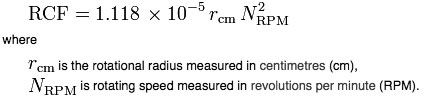
rcf-equation

RCF or RPM?

From this it is clear that the correct unit for the amount of centrifugation to use in a given protocol is RCF (a.k.a. x g).

But most centrifuges, especially microcentrifuges, only have settings for RPM. So unless you are lucky enough to have a centrifuge with an RCF setting, you will have to work out the corresponding RPM that will be required for YOUR centrifuge to achieve the RCF set out in a protocol.

This can easily be done by taking your ruler, measuring the radius of your centrifuge rotor and plugging the numbers into an online converter such as this one from DJB Labcare. Alternatively, the same site also has a very useful nonograph that you can print out and keep on your bench to use for rcf to rpm conversions.

The take home message is that centrifugation speeds in quoted in RPM will only be constant for centrifuges with the same rotor radii. If you use an RPM setting from a protocol where someone used a centrifuge with a different radius from yours, you will get a different RCF. Often the difference will not be significant enough to affect the sample or the centrifuge, but sometimes, e.g. if you use an RPM setting that was originally meant for a microfuge in an ultracentrifuge, it can cause problems.

A more common mistake is to assume that RCF=RPM which can result in lab disasters, like these!

As ever, and especially since I’m a biologist pretending to be a physicist today, please feel to comment!

Articles in your inbox

Enter your email to be informed when we publish more articles like this on BsB, and also get access to all of these goodies:

  • Free ebooks and audiobooks on the topics that matter to you
  • Access to Member’s-only articles and Videos
  • Advance notice of new webinars and eBooks
  • Access to make comments and ask questions on BsB


What to read next

How Proteases and Protease Inhibitors Work

Proteases: wild, mysterious, destructive.  What are these untamed elements ravaging your precious lysate? How can a drop of EDTA or a smidge of “cocktail” protect that sample, which is gently cradling your hopes, your dreams, and your desire to survive the next lab meeting? Brace yourself for a biochem flashback: in this article, we’ll explain [...]

DEPC: The Wicked Witch of RNA?

If you have ever worked with RNA, you know about DEPC (diethylpyrocarbonate). You add it to water at a concentration of 0.1%, shake or stir, incubate at 37°C for two hours or at room temperature overnight and, as if targeted by a magic bullet, the RNAses that may have been in the water are gone. [...]

How is Lab Grade Water Purified?

There’s something in the water, and it would love to go after your experiments. Straight out of the tap, water contains microorganisms, endotoxins, DNase and RNase, salts and other impurities that could gobble up your experiment in one bite. Of course we avoid this drama completely by using purified water from which these nasties have [...]

How Thermophiles Survive, Part II: DNA

In part I, I answered the question, “How do proteins in thermophiles survive under high temperatures?” In this part, I’ll look look at how nucleic acids survive -thrive, even- in conditions that are too hot for most of us, but ideal for a number of organisms, including the one that gave us Taq polymerase and [...]

About the author

Nick Oswald

Nick Oswald started Bitesize Bio on a Macbook on his kitchen table in 2007 while in his 7th year of working as a molecular biologist in biotech. He made it his day job in 2010 and has been loving it ever since.

What do you think?

12 comments

  1. from Ron on

    The corollary to using RCF is that if you do specify RPM, you MUST specify the rotor used.

  2. from Paul N. Hengen on

    You can do one better than creating a nomograph for yourself. Print one out for every centrifuge in your lab and post it on the wall next to the appropriate centrifuge. Some kind person in our lab did this and gained many new friends. Plus some other people then added lines on the nomograph and labeled them with helpful tags like “last spin for mini-prep kit XYZ”, etc…

  3. from Aaron Stephan on

    How about RCF avg vs RCF max? I think the difference is that different parts of your tube will experience difference relative forces depending on how far that given point is from the center of the rotor. Is it customary to report the average or maximum?

  4. from Abducted Alien on

    http://xkcd.com/123/

    I did study psysics a long time ago, but jumped over to biology, so I just have to believe what Bond says in that :)

  5. from Paula on

    Hi Nick,
    I also would like to understand the difference between RCF max and RCF avg. I need to convert settings from someone else’s protocol and would like to know if what I should use is one or the other. Can you explain? Thanks!

  6. from Sean on

    I too would like to know about Avg vs. Max RCF values! What should I use when adopting a protocol from publications?

  7. from Jode on

    The average versus maximum RCFs becomes important when there is a significant difference between the radius as measured at the top of the centrifuge bottle compared to the bottom of the bottle once mounted in the rotor. This is a reflection of the fact that the instrument spins at a particular RPM, so the actual force on the sample at the top of the bottle will be less than it is at the outside bottom corner, where the pellet will form. The Max RCF value reflects the force at the bottom corner, while average RCF is calculated using the average of the minimum and maximum radii and reflects the force exerted roughly at the center of your sample.

    I think most people write their protocols using the average RCF, but this is something to consider if you are scaling a prep up. If the person who developed the protocol was using a 40ml centrifuge tube(where max and average RCF are similar), then when you scale it up to a 1L bottle (which generally has a very large sample radius difference once in the rotor) the pelleting step may not be as efficient at the same RCF, although using average RCFs attempts to mitigate these differences.

    So although I think it is better to use RCFs in protocols than RPMs, you still need to have some information about what scale/rotor was being used by the protocol developer in order to make informed decisions.

  8. from Tess on

    Why don’t you write the conversion formula so that we know what to use for what.I want to convert rpm to g but everywhere people are talking about the difference.Why not put a formula

  9. from Roberto on

    Hey Tess,
    you can get RPM from RCF just by applying some second-grade school arithmetics to the formula provided.

    RPM = [RCF / (1.118*10^-5 * r)]^0.5

    e.g. for 16.000g on a 10 cm rotor,
    RPM = (16000 / (1.118*10^-5 * 10)^0.5 = 11.962 RPM

    You can simplify the formulae a bit of you like.
    For example, with just a slight approximation,

    RPM = 300 * (RCF / R)^0.5

    e.g. for 16k RCF, and a 10-cm rotor,
    RPM = 300 * (16000/10)^0.5 = 12.000 RPM
    (a good approximation; the longer formula gives 11.963 RPM)

    and

    RCF = 11.2 * r * kRPM^2 (where kRPM is thousands of RPM)

    e.g. for 12.000 (12k) RPM and a 10-cm rotor,
    RCF = 11.2 * 10 * 12^2 = 16.128g
    (a good approximation; the longer formula gives 16.099 RCF)

  10. from on

    Can somebody PLEASE tell me the proper way to measure the radius? Do I run the measuring tape inside and down to the end of the shield and read where the motor shaft hits the tape, or do I take a horizontal reading from the motor shaft to the (outside) end of the shield?

    I haven’t found a single site that gives specifics for “measure the radius”.

    Thanks,
    C

Subscribe to Channels

To receive information about any of our new channels click on the button below.
subscribe to the channel newsletter »

Write for us

Have a short tip, a written
article or a video you'd like
to see published?
write for us »