
Criticism is not just valuable, it is essential for a person’s development as a scientist, or anything else for that matter.
Well that’s not entirely true. Not all criticism is valuable, it has to be the right kind of criticism. It has to be constructive and better still, well delivered in order to inspire the person receiving the criticism to take it on board and use it to improve themselves or their performance.
What kind of mentor will you be?
At some point in your career (or perhaps now) you will have mentoring responsibilities over another person. This is of course a huge responsibility as you will have great influence over the person. And you have two choices.
Choice 1: Stoke your ego and reap possibly irreparable, damage on your mentee’s confidence and career. It’s easy. Just deliver harsh, unconstructive criticism day on day and make asserting your superiority over them a priority. Their confidence, abilities and respect for you will grow poorly under your mentorship. But it will make you feel superior.
Choose a free resource to help you move forward
GUIDE
How to Get Clarity and Hold On To It
DOWNLOAD
The Happy Scientist Reference Pack
Choice 2: Put in care and effort to deliver criticism in a way that allows the person you are trying to help to grow, while building their confidence and their respect for you at the same time. This takes dedication but you, and your mentees, will reap the rewards from this in the future.
I am assuming that you’d go for choice two, although, like me you are probably aware of a number of people who go for the first approach.
So here are some ideas on how to deliver criticism constructively and effective. It is not a comprehensive or systematic approach, just my ideas and thoughts (and I would be delighted to hear your ideas and thoughts in the comments section…).
Be Specific
The first thing to do is to consider WHAT you are criticising and address it specifically. Don’t generalise as this is confidence sapping and pointless.
“You need to work on your bench skills” is non-specific, overwhelming and damaging
while …
“I think you should work on your midipreps, your yields are too low” points out a specific problem and if delivered correctly could inspire your mentee to improve the way they work.
Encourage self-questioning
Don’t impose the solution. Encourage your mentee to think of the solutions for themselves, while interjecting with ideas and knowledge of your own. This helps your mentee to be part of the solution and take ownership if it.
Point out the benefits
Because sometimes the benefits of working to improve something might not be obvious to your mentee, or putting the benefits into perspective might provide that last motivational push that encourages them to take up your advice.
Listen
What your mentee has to say about the situation is just as important as your worldly wisdom. They might have an insight or nugget of information that changes your perspective on the problem too. The communication should be two way and you should maintain the humility to recognise that you don’t, in fact, know everything.
Point out the good parts first and last
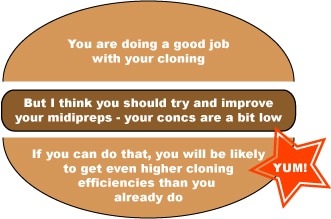
The “sandwich technique” (also known as the “hamburger technique” ) is something I learned at Toastmasters and I think it is a great concept. It simply means that when you deliver criticism you give some praise first, then the criticism, then some praise to finish with.
The criticism is the meat in the sandwich, making the criticism much more tasty, and making everyone a lot happier.
Finally… Don’t preach
My pet hate is watching more experienced scientists preech solutions to their mentees. It’s like they are trying to establish a pecking order, bolster their own egos and make the mentee feel small. In fact I think they do this to try and garner respect for their knowledge, but this a poor strategy for acheiving this.
Preaching/lecturing/”getting on your high horse” or whatever you want to call it just turns people off and in the worst case can damage confidence.
If you want respect, earn it by building relationships with your mentee, delivering advice and criticism with humility and earning a reputation as a mentor who can be trusted and relied upon.
The confidence of your mentees grows like a flower. You can easily get on your lawnmower and cut it down, or you can put in the effort and dedication to help them flourish, it’s your choice.
What do you think? Make your criticism constructive if you can!! :)
You made it to the end—nice work! If you’re the kind of scientist who likes figuring things out without wasting half a day on trial and error, you’ll love our newsletter. Get 3 quick reads a week, packed with hard-won lab wisdom. Join FREE here.