
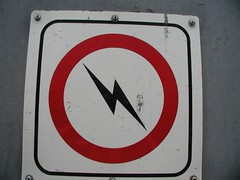
 All over the world, molecular biologists are tragically wasting hours of their life running DNA gels using tris-based conduction buffers like TBE or TAE.
These buffers are known to overheat at high voltages, causing problems with gel integrity, sample denaturation and more. Because of this, molecular biologists are forced to keep the voltage of their gels to a maximum of 5-10 volts/cm (e.g 100 volts for a 10 cm gel) and extend the running time, sometimes to hours.
Although long gel runs, like long restriction digests, are often used as a convenient coffee break opportunity they can also eat into the molecular biologist’s precious time, leading to longer and less efficient working days.
But, in 2004, a team of scientists from Johns Hopkins came up with solutions (pardon the pun) to this problem. They have developed and verified three conductive buffers that stay cool during electrophoresis, allowing the voltage to be racked up to a massive 35 volts/cm without any problem, reducing the time taken to run gels by up to 7 times.
Choose a free resource to help you move forward
download
The Molecular Cloning Cheat Sheet
PROTOCOL
Chemically Competent Cells Protocol
Between them, the three buffers cover all of the molecular biologist’s DNA gel needs. The buffers are:
-
- 10mM sodium boric acid (Na2B4O7/Borax)
For standard applications (separation of DNA fragments from 100bp-5kbp).
- 10mM sodium boric acid (Na2B4O7/Borax)
Our lab’s standard DNA gel buffer has become 20 g of Borax into 1 l of water which gives a 20x stock solution. Small gels run in 10-15 minutes at 200V.
- 5mM lithium acetate (LiOOCCH3, CAS:546-89-4)
For separation of fragments longer than 3 kbp. - 1mM lithium boric acid (Li2B4O7, CAS:12007-60-2)
For separating small DNA fragments and ssDNA
The sodium borate and lithium acetate buffers can also be used for RNA gels in place of MOPS buffer.
Simply make up the required buffer, use the same buffer in the gel and the tank, turn up the voltage to 10-35 volts/cm and watch that DNA go.
Despite this excellent work, there are still thousands of molecular biologists who have not yet been shown that there is an alternative to wasting their precious hours using tris buffered gels.
Help us to eliminate this tragedy by spreading the word about this method for faster, cooler DNA gels. You can do this by clicking the link below this article to e-mail it to your molecular biologist friends. We, and they, thank you for your help.
Further reading:
1. Brody and Kern(2004) Biotechniques 36 p214
2. Brody et al (2004) Biotechniques 37 p598 (Free registration required)
3. Hudson, Biocompare protocols (a protocol giving a quick overview)
Photo: Klis
You made it to the end—nice work! If you’re the kind of scientist who likes figuring things out without wasting half a day on trial and error, you’ll love our newsletter. Get 3 quick reads a week, packed with hard-won lab wisdom. Join FREE here.


