Fast restriction digests?

About the author

Max Haeussler

To enable tagging you will need to register on Bitesize Bio. We're sorry for the inconvenience, but it's free, only takes a few seconds, and it will enable you to view our seminars for free, ask questions from the professional community, and take part in the lively community of Bitesize Bio

restriction-digest-microwave.jpgIn the old days, restriction digests were a great excuse for long lunch breaks. Come back 1-2 hours later and it’s done.

But, just to ruin our fun, Fermentas then NEB started to offer ranges of restriction enzymes that do their job in 5 minutes. Nothing changed with these enzymes – someone just figured out that 60-120 minutes was just a number selected at random, probably by someone who wanted a longer lunch break.

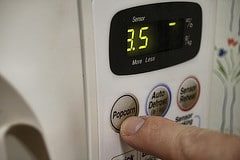
But what about this? After a hint by a friend, I started putting my digests into the microwave oven now for 10 seconds at maximum power (700 Watts) – and it turns out that this is all that is needed for a full digest!

I’ve no idea why this works, but the idea doesn’t seem to be that new.

The only explanation I found is that the microwaves make the molecules faster, increasing the probability that the enzymes find their sites on the DNA but that sounds a bit hand-waving to me. Heat makes molecules move faster, so the microwaves aren’t doing anything special. Are they?

How do you think this works? Or, have tried this method out? I’m looking forward to your comments.

Photo: Aim and Shoot


14 comments on this article already!

  1. Ian

    2 years ago

    Have you tried the same reaction side by side without the microwave?

    Some reactions just are amazingly fast. I remember trying to do a partial digest with SmaI once — I couldn’t move fast enough to catch a partial digest when I used a 1 ul volume of enzyme. (That was about 15 years ago, so before the special fast digests, whatever they are. But I’ve still usually used 30 – 60 minutes for my reactions anyway.)

  2. ramunas

    2 years ago

    Anyway, Fermentas had good idea to offers these fast digest – and I think they are a bit modified.
    Does your super fast digestion work after only one 10 sec. incubation?

  3. Dan

    2 years ago

    I admit that I haven’t tried yet without the microwave. Should have been the first thing to try.

    Is there any proof that Fermentas really changed the enzymes?

  4. Nick

    2 years ago

    The NEB enzymes are un-modified at least. According to their information on their “time saver” enzymes:

    “Unlike other suppliers, there is no special formulation, change in concentration or need to buy more expensive new lines of enzymes to achieve digestion in 5 minutes”

  5. ramunas

    2 years ago

    during fermentas presentation i understood that they modified enzymes, but maybe that’s only marketing trick – will ask some friends who work(ed) there – it’s local company.
    will check it out tomorrow with Ava II (by fermentas) enzyme on lambda dna and specific amplicon – as for doctor it was usually more exciting for me to work in a lab than do surgery :)

  6. Patrick

    2 years ago

    Here is a link to a patent disclosure that discusses this approach in more detail. There they favored a longer time, approx 5 min, on a power setting of 1. I’m running an experiment today. Will post the results later.

    http://www.patentstorm.us/patents/5350686-description.html

  7. Nick

    2 years ago

    Partick, Thanks for that information – very useful indeed. And I am looking forward to the results!

    By the way – did you read my (late) comment on the ligation independent cloning post? If you are still interested in setting up a LIC vector construction project, drop me an email using the contact button above.

    Thanks,

    Nick.

  8. bala

    2 years ago

    interesting! will try this and let you know the results.

  9. Liam

    2 years ago

    Bala

    Would be great if you could post the results, have just found this site and am rather enjoying it, got some nifty tips for my not so nifty cloning.

    Cheers
    Liam

  10. Dave

    2 years ago

    These anecdotes are fun, but if we are really scientists can’t we do a bit better than this?

    In about 1992 I heard about this microwave protocol. So I actually did a rough and ready experiment. Identical reactions, microwave one for however long was recommended (1 min possibly?), leave another on the bench for the same amount of time, a third at 37C. No difference between them, tested with several enzymes. It implies that many enzymes are very fast indeed even at suboptimal temperatures.

    Is it telling that since 30 Jan nobody has posted back to say that they observe a significant difference with microwaving compared to normal incubation? Is this a long-running lab myth, or is there a peer-reviewed publication out there saying otherwise?

  11. Nick

    2 years ago

    Dave,

    Thanks for this. It sounds like you have done the experiment and shown that microwaving is not required for full digestion.

    There is apparently a publication on this – it is cited in one of Paul Hengen’s excellent TIBS articles (Trends in Biochemical Sciences 19(12):556-557 link: ftp://ftp.ncifcrf.gov/pub/methods/TIBS/dec94.txt) but the original article is published in the Methods in Molecular and Cellular Biology journal, which is print only, so I can’t get access to it unfortunately.

    Personally, I very much doubt that microwaves can speed up restriction digests. As you mention, and anyone who has tried to do a partial digest without a substantial dilution of the enzyme stock will know, restriction enzymes are extremely fast so can digest a lot of DNA in a few minutes – with or without microwaves.

    But that said, this article is intended only to provoke discussion. Myths (I’m 99% sure it is a myth, but you never know) like this are common in the lab so discussion of them is both fun and useful. I hope you agree.

  12. Dan

    2 years ago

    I agree, Dave. The only good argument we have in this thread is still only the patent. I promise to do some more rational testing. Really.

  13. Dan

    2 years ago

    I have the impression that biology is a discipline where myths abound. ETB, ligation-tips, the meaning of LB or SOC, the optimum amount of DNA for a transformation – there are tons of subjects that are as basic as they have never been questioned by thousands and generations of researchers worldwide. Myths are still widely taught at university in biology and once this happens they are difficult to kill afterwards. As a computer scientist I am still amazed by the number of myths that are kept alive and are in circulation, so much that I have come to trust very few sources.
    I am not sure but I have the impression that other scientific disciplines deprecate them more. It seems to me that myths are a pecularity and an integral part of biological (and probably also medical?) labs.

    However, they definitely attract attention. I feel a little bad that I seem to have used a myth to increase hits to this post and in doing this even furthered its reproduction.

    If anyone knows a good book about memes or the mutational processes, the evolution of myths in science and their selective advantages that they confer to individual researchers I would appreciate any references or ideas.

  14. Andy

    2 years ago

    I have tried it with digestion lambda DNA using HindIII, but the positive control, digesting dna in 37 degree water bath, is completely digested in 10 sec.

Leave a Reply

To leave a reply you now have to register on Bitesize Bio. We're sorry for the inconvenience, but it's free, only takes a few seconds, and it will enable you to view our seminars for free, ask questions from the professional community, and take part in the lively community of Bitesize Bio

Register Now on Bitesize Bio

  • get access to our live online seminars
  • get members-only free downloads (coming soon)
  • ask and answer questions in our community
  • keep track of your favorite articles in myBsB
  • be part of the coolest bioscience site on the web
Register Log In