Buying competent cells from commercial suppliers is convenient, provides a guarantee of quality, and gives access to strains with a variety of in-built traits that assist with things like maintenance of plasmid integrity (more on these traits later). However, this can be an expensive business.
Alternatively, competent cells of any strain, including the specially-constructed commercial strains, can be prepared easily in the lab (for protocols see here and here). The critical factor is whether you can generate cells of high enough competence yourself.
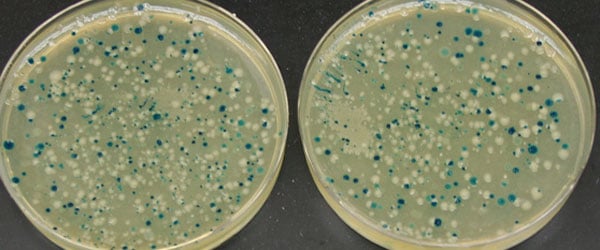
Competence is a measure of how efficiently the cells can be transformed and is defined as the number of colonies formed per µg of supercoiled DNA. It can be easily calculated by transforming the cells with a known amount of supercoiled DNA and then dividing the number of colonies formed by the amount of DNA (in µg) used. The level of competency that is required depends on the application. Here are a few examples:
| Competence (cfu/µg) | Application |
| >1×10⁹ | Genomic library construction, Quikchange |
| 1×10⁶ | Routine cloning/sub-cloning |
| 1×10³ | Transformation of circular plasmid DNA |
If you can generate cells with these sorts of competencies, then there is no need to buy in competent cells, unless you are from a super-rich lab, or use competent cells very infrequently. However, although the protocols are simple, obtaining homemade cells with high competence is a bit of a knack. Here are some tips that should help:
Choose a free resource to help you move forward
download
The Molecular Cloning Cheat Sheet
PROTOCOL
Chemically Competent Cells Protocol
- Start with a nice, freshly-streaked colony
- Grow the cells in detergent-free glassware (wash well with DI water prior to autoclaving)
- Harvest the cells at around OD=0.5 to 0.7 as this is when they are happiest
- Put the cells on ice when they reach the required OD and keep them cold all through the protocol
- Chill EVERYTHING before performing the protocol. This includes pipettes, tips, solutions, centrifuges, etc. If you can do the whole thing in a cold room, even better! (A bit uncomfortable, but worth it!!)
- Treat the cells very gently – keep pipetting to a minimum and centrifuge cells at low speed so that tight pellets are not formed. It is worth accepting that you will lose even as much as 50% of the cells throughout the procedure in exchange for gentle centrifugation and pipetting.
- Work quickly, but carefully
- For very high competencies, a simple trick is to resuspend the cells at a higher density in the final step – so there are fewer aliquots but more cells/aliquots.
For a constant supply of high-quality competent cells, download bitesize bio’s chemically competent cells protocol cheat sheet—your reliable set of instructions to prepare chemically competent cells in the lab.
Articles in this series:
- E.coli Electroporation vs Chemical Transformation
- Competent E.coli: To Buy or Not to Buy? (this article)
- Choosing A Competent E.coli Strain
Photo: Jessica Shannon
You made it to the end—nice work! If you’re the kind of scientist who likes figuring things out without wasting half a day on trial and error, you’ll love our newsletter. Get 3 quick reads a week, packed with hard-won lab wisdom. Join FREE here.