Low cost DNA gel documentation

Equipment for DNA gel photography, such as photographing DNA gels stained with ethidium bromide (or other fluorescent dyes), doesn’t have to cost thousands of dollars. These days, great pictures can be obtained with a standard digital camera and an orange filter. Here’s how.
You will need:
- A digital camera
- A Cokin orange filter 002A or similar (This does not have to fit onto the camera, a square filter will do.)
- A polystyrene ice bucket with a thick (3-5cm bottom)
- A UV transilluminator
To build it:
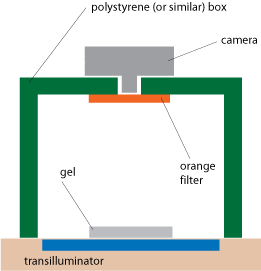
- Cut a hole in the bottom of the box that is big enough for the camera lens to fit into.
- Tape the filter over the hole, inside the box.
- Set the camera flash to off and the mode to black & white.
- Push the camera’s lens tube into the hole (or place the camera lens over the hole if there is no lens tube). Depending on the shape of your camera, you may have to modify the box to ensure that the camera is pointing straight into the hole.
- Place your DNA gel onto the transilluminator and put the box over the gel.
- Turn the transilluminator and the camera on. You should now be able to see the stained DNA on the gel in the viewfinder of the camera.
- To get a quality picture and good detection limits you will have to play around with the ISO, shutter speed, and aperture. This will be specific to your camera, but the setting ISO 200, Shutter speed 1/3, Aperture 8.0 worked for me—so this may be a useful starting point for you.
Update: Here’s a schematic diagram that shows how the whole thing should fit together. Let me know if you have any comments or questions.
One thing to remember when imaging your gels is to minimize the time on the UV transilluminator as UV light can damage DNA and impact your downstream applications if you are cutting bands out of the gel.
For more tips, tricks, and hacks for getting your experiments done, check out the Bitesize Bio DIY in the Lab Hub.
25 Comments
Leave a Comment
You must be logged in to post a comment.
This is great. I am going to try this tomorrow. Thanks
Hi Nick,
Thanks for this post. Can you give an example of the filters you would use? Would a cheap orange light filter like this be fine: https://www.amazon.co.uk/Neewer-Transparent-Correction-Lighting-Magenta/dp/B016Q0BBN2/ref=sr_1_1?ie=UTF8&qid=1481141244&sr=8-1&keywords=orange+light+filter
Best,
Pat
Thanks for such a nice article. What we should do if we want to make an in-house UV transilluminator? It would be really helpful if you comment on that or send me any relevant link. Thanks